
The honest answer to both questions is more uncomfortable than most leadership content will admit
Most leadership content answers the first question and ignores the second.
The first question gets a lot of attention because it is aspirational. What separates C-suite leaders from everyone else is the kind of content that gets shared, saved, and turned into a carousel. People want to know the formula. They want the list of traits and habits and mental models they can adopt to close the gap between where they are and where they want to be.
The second question is more interesting, more honest, and almost never asked. Because the answer to it reveals something about executive leadership that the aspirational content has no incentive to acknowledge.
Let me take both seriously.
What C-Suite Leaders Actually Have
The first thing to say about this question is that most of the popular answers are incomplete.
Decision-making ability, strategic vision, emotional intelligence, communication skills, these are real competencies, but they describe many people at many levels of an organization. Directors have them. Senior managers have them. Plenty of individual contributors have them in abundance and never reach the C-suite. Treating these as the differentiating factors confuses correlation with cause.
The things that actually separate C-suite leaders from the people below them in the organization are fewer and less flattering than the aspirational lists suggest.
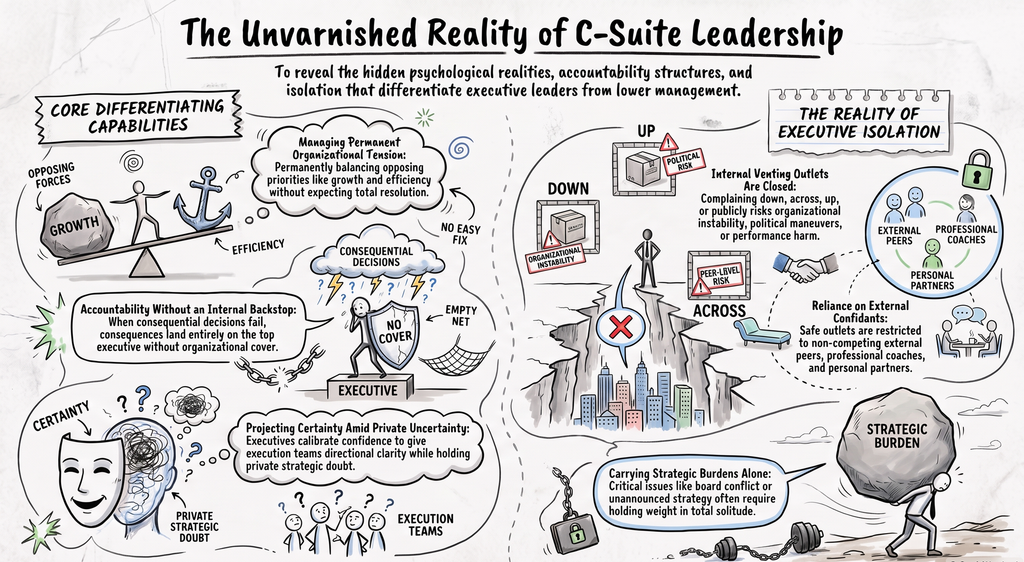
The first is the ability to hold irresolvable tension without reaching for a resolution.
Every organization runs on competing priorities that cannot be simultaneously maximized. Growth and efficiency pull against each other. Innovation and operational stability pull against each other. Short-term shareholder return and long-term organizational health pull against each other. Speed and quality pull against each other.
People below the C-suite experience these tensions as problems to be solved. They look for the framework that resolves the conflict, the prioritization model that tells them which thing wins. The C-suite leader’s job is not to resolve the tension. It is to manage it permanently. To hold both sides of a genuine organizational dilemma and make directional bets without the comfort of knowing the right answer, because there is no right answer, only tradeoffs with different risk profiles.
Most people find this intolerable. The ones who find it, not comfortable exactly, but workable, tend to be the ones who eventually sit in the chair.
The second is a longer time horizon than the organization naturally produces.
Organizations are short-term systems by design. Quarterly earnings, annual reviews, project timelines, sprint cycles, the structures that govern organizational life are built to produce accountability over near-term intervals. This is necessary and useful. It is also systematically biased against the decisions that matter most.
The investments that reshape an organization’s competitive position, the culture changes that require five years to become real, the capability builds that look like costs for three years before they look like advantages, these are decisions that the organizational incentive structure works against. Every internal system is pulling toward the decision that looks right this quarter.
The C-suite leader’s specific job is to make those long-horizon decisions anyway, while managing the short-horizon accountability systems that will evaluate them against the wrong timeframe. That requires a tolerance for being wrong in ways that the current measurement period cannot assess, and a confidence in your own analysis that does not depend on near-term validation.
The third is genuine accountability with no backstop.
This one is the most straightforward and the least discussed. At every level of an organization below the C-suite, there is someone above you. When something goes seriously wrong, there is an escalation path. There is someone whose job it is to absorb some portion of the consequence, to make the hard call if you cannot, to give you cover if the decision was reasonable even though the outcome was bad.
The C-suite leader, and the CEO in particular, has no backstop inside the organization. The board is not a backstop. The board is an oversight body with its own interests and its own accountability. It is not there to absorb your problems. When something goes seriously wrong at the top of an organization, the consequence lands on the person at the top. Not partially. Entirely.
Most people who think they want to be in the C-suite have not fully reckoned with what that accountability structure feels like when a consequential decision turns out to be wrong. The title and the compensation reflect the weight of that exposure, but the weight itself is not something you can understand from the outside until you are carrying it.
The fourth is the ability to make people feel certain when you are not.
This is the one that leadership content almost never names directly because it sounds like manipulation and it is uncomfortable to frame as a competency.
The people below the C-suite leader in an organization are, to varying degrees, taking their cues about the organization’s direction, stability, and prospects from the behavior and communication of the leadership team. An executive who visibly carries their uncertainty into every communication does real damage to the organization’s ability to execute. Not because honesty is bad, but because people at execution level need directional clarity to function. A team that believes the strategy is sound and the direction is clear will outperform a team that believes leadership is unsure, even if the uncertain leadership team is making better decisions.
The C-suite leader’s job includes projecting confidence that is calibrated, not false, but not equal to their private level of uncertainty. That calibration, knowing when to share doubt and when to hold it, who needs to know and who needs certainty, is a skill that feels counterintuitive to people who have been told their entire career that authentic leadership means showing your full self. It is not dishonesty. It is the executive version of a surgeon who has concerns about a procedure but knows that expressing them to the patient in the operating room at that moment serves no one.
Who They Complain To When Things Go Wrong
Now the more interesting question.
Everyone at every level of an organization develops coping mechanisms for the frustrations of organizational life. The manager vents to a trusted peer. The director complains to their partner over dinner. The VP sends a message in a side channel. These release valves exist everywhere in the organizational structure because they are necessary. Carrying every frustration internally without any outlet is not a management philosophy. It is a path to poor decision-making and worse health.
The C-suite leader has the same need and almost none of the safe channels.
They cannot complain down. A CEO who vents to a direct report about the board, a CMO who expresses frustration to their team about the CEO, an executive who lets their doubt about a strategic direction show to the people executing it, these are leadership failures with real organizational consequences. The information travels. It creates anxiety, political positioning, and quiet alignment against the thing being criticized. The C-suite leader who forgets this and treats a direct report as a confidant eventually pays for it.
They cannot complain across. Peer executives are competitors for organizational influence, budget, and the CEO’s attention, even in organizations with healthy cultures. A CFO who expresses reservations about a CMO’s strategy to the COO is not having a therapeutic conversation. They are making a political move, whether they intend to or not. The C-suite peer relationship is fundamentally different from the peer relationship two levels down in the organization, where the stakes of peer dynamics are lower and the political dimension is less acute.
They cannot complain up. The board relationship for an executive team is a performance relationship. The board evaluates leadership. Expressing frustration, doubt, or complaint to the board is functionally a performance review with no upside. There are specific moments where a CEO must be honest with the board about organizational difficulty, but that is disclosure, not venting. The emotional reality of executive frustration is not what board relationships are structured to absorb.
They cannot complain publicly. The external visibility of a C-suite role means that frustration expressed publicly, in any venue, has organizational consequences. The executive who posts about internal difficulty, who speaks candidly to a journalist about strategic challenges, who lets anything about the internal reality of organizational struggle reach the outside is not being authentic. They are being careless about a dimension of their role that has real people depending on it.
So who do they actually talk to?
The honest answer is a short list.
A peer outside the organization. Other C-suite leaders from non-competing organizations, especially those navigating structurally similar challenges, are the most valuable confidants an executive has. The trust structure works because there is no organizational entanglement. The understanding works because the person on the other side of the conversation has actually sat in the chair. This is why executive peer networks and roundtables exist and why the executives who invest in them consistently report that they are among the most valuable relationships they have professionally.
An executive coach. The executive coach relationship is specifically structured for this purpose. It is confidential, external, and the coach’s incentive is the executive’s effectiveness rather than their own organizational advancement. A good executive coach is not a therapist and not a consultant. They are someone who holds the executive’s thinking without absorbing it, reflects it back with enough distance to make the irrationality visible, and asks the questions that the executive cannot ask themselves because they are too close to the situation.
A partner or close personal relationship. This one is imperfect and everyone in it knows it. A partner who is not in the professional world of the executive cannot fully understand the context of what they are carrying. But the need to be known by someone, to be seen as a full person rather than a role, is not optional. The executives who have no outlet at all, who carry everything without any external processing, produce a specific kind of damage over time that shows up as brittleness, disconnection, and decision-making that has lost its human dimension.
Sometimes, nobody. This is the answer that leadership content never gives, and it is the most honest one. There are categories of organizational difficulty that a C-suite leader genuinely cannot discuss with anyone who is in any way connected to the situation. Board conflict. Executive team performance concerns. Strategic decisions that have not been announced. Regulatory or legal exposure. In these moments, the C-suite leader holds the weight alone. Not temporarily, not while they find the right confidant, but sometimes for months, sometimes indefinitely.
The capacity to function under that weight, to make sound decisions while carrying things that cannot be shared, to remain present and effective in external relationships while managing a private burden that cannot be disclosed, this is not on any leadership competency list I have ever read. But it is one of the things that the chair actually requires.
What This Means if You Are Building Toward That Level
If you are in a director or VP role and the C-suite is where you are headed, there are things worth understanding before you arrive that will serve you better than the aspirational competency list.
Start building the peer network outside your organization now, not when you need it. The relationships that function as your confidant channel at the executive level take years to develop the trust required to serve that purpose. Most executives build them too late, after they are in the role and already carrying things they cannot put down.
Get comfortable with irresolution. Practice holding organizational tension without reaching for the framework that resolves it. The higher you go, the more of your cognitive and emotional energy will be occupied by problems that do not have answers, only management. The practitioner who can tolerate that, who can function effectively without the satisfaction of resolution, is the one the organization will eventually put in charge of the things that matter most.
And understand the accountability shift clearly. The C-suite is not more of what you are currently doing. It is a different relationship to consequence. The decision you make at the top of an organization, when it is wrong, lands differently than a decision made at the level below it. Not because the stakes of the individual decision are always higher, but because the accountability has no distribution. It does not get shared. It does not get absorbed by someone above you. It lands on you.
That is not a reason to avoid the level. It is a reason to understand what the level actually is before you spend years building toward it.
The people who thrive at the top of organizations are not the ones who found the job easier than they expected. They are the ones who understood what it actually cost and decided the work was worth it.
Sources: Center for Creative Leadership, “Executive Isolation and the Challenge of Confidential Support,” 2024; Harvard Business Review, “The Loneliness of the C-Suite,” 2012 and updated 2024; Korn Ferry Institute, “Executive Resilience and Decision-Making Under Uncertainty,” 2025; Stanford Graduate School of Business, “What Makes Great Leaders Great,” Executive Education Research, 2025; McKinsey & Company, “The CEO Moment: Leadership for a New Era,” 2020 and 2025 follow-up.